

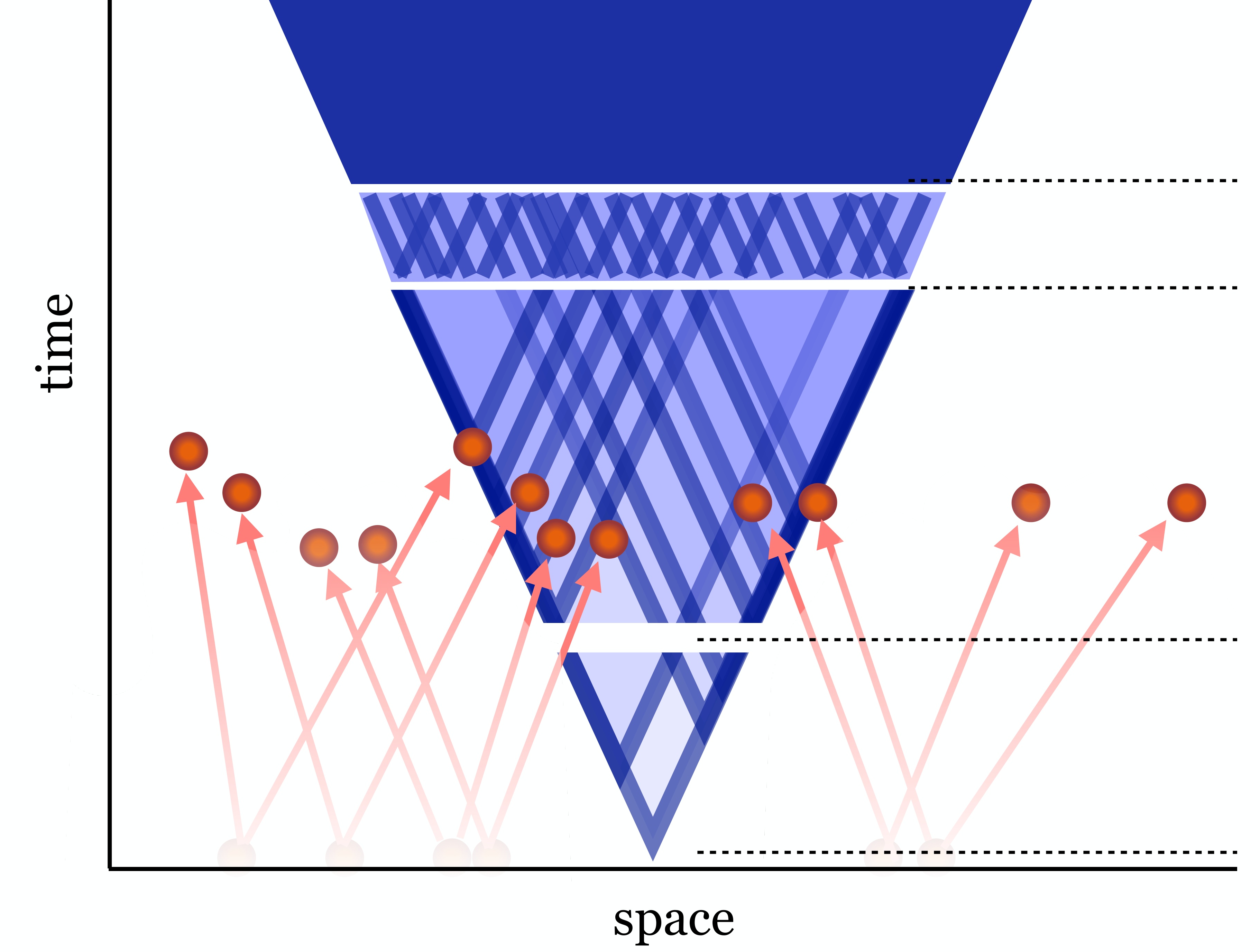
A team of ICTS researchers have provided a critical missing link in statistical mechanics. Subhro Bhattacharjee, Sthitadhi Roy, former ICTS postdoctoral fellow Sibaram Ruidas and Roderich Moessner (Max Planck Institute for the Physics of Complex Systems in Dresden, Germany) have illustrated how fundamental chaotic behaviour emerges from ordered physical states.
In condensed matter physics, a central challenge is understanding how complex quantum systems transition from ordered states into microscopic chaos. At very low temperatures, many materials exhibit highly structured behaviour governed by independent, wave-like excitations known as quasiparticles. However, establishing the precise mechanisms by which this stable regime ultimately breaks down and thermalizes remains a significant open question. In this work, the authors have comprehensively characterized this crossover.
By introducing dilute random defects into the background of an otherwise ordered state of an interacting spin chain, the researchers successfully mapped the spatial and temporal evolution of the system's transition into chaos. They discovered that this breakdown is not instantaneous but unfolds through a distinct intermediate phase. When quasiparticles encounter these localized impurities, their scattering seeds hotspots of chaos which then expand in space and time within their causal light cones. As the system evolves, these light cones overlap and collide leading to a cascade. This triggers an avalanche of subsequent scattering events that eventually engulfs the entire system, driving it into fully-developed many-body chaos. The study identifies the microscopic dynamical processes through which ordered physical states evolve into chaotic behaviour, addressing a longstanding question in statistical mechanics.
The publication has been selected as an Editors’ Suggestion in Physical Review B.