
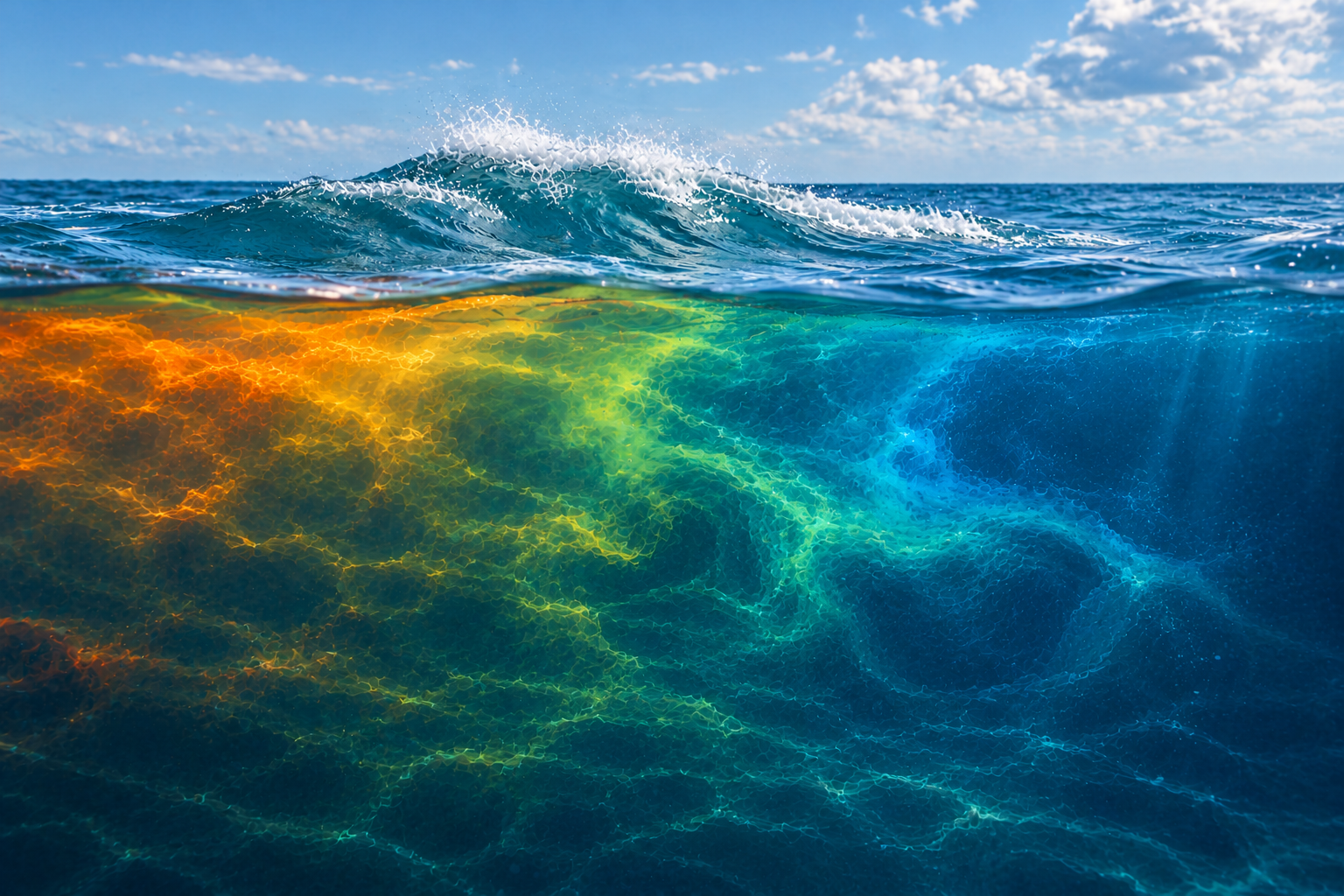
ICTS researchers have revealed an important and previously under-appreciated role of ocean waves in the transport and mixing of heat, carbon, oxygen, and other nutrients. ICTS joint faculty member Jim Thomas and former ICTS postdoctoral fellow C.P. Sanjay’s work could lead to more realistic estimates of ocean tracer transport and contribute to improved understanding and prediction of climate variability and changes in marine ecosystems.
In regulating the Earth’s climate, the oceans play a vital role by transporting and redistributing tracers such as temperature, salinity, carbon, oxygen, and other nutrients. For example, oceans absorb carbon from the atmosphere and transport it to the deeper ocean, helping regulate atmospheric carbon levels. Similarly, the distribution of oxygen and other nutrients in the ocean are essential for healthy marine ecosystems. Therefore, understanding how these tracers are transported and mixed in the ocean is important for improving the predictions of climate and marine environmental changes.
While considerable attention has been given to the role of ocean eddies — large rotating bodies of water — in transporting and mixing these tracers, the role of ocean waves has received much less attention. Since waves exhibit oscillatory motion, their effect was often assumed to be largely reversible, with tracers simply being displaced and returned to their original positions. As a result, wave-driven mixing was generally associated with more complex interactions between waves. However, recent oceanic observations have suggested that waves may contribute significantly to tracer mixing, particularly at scales smaller than about 10 km. Motivated by these findings, the researchers investigated how ocean waves influence the transport and mixing of tracers.
Their theoretical and numerical results reveal that waves can produce irreversible stirring of tracers even without complex wave interactions. While a single wave can temporarily stretch and distort a tracer field before returning it towards its original state, two or more waves travelling in different directions can produce irreversible stirring. Their numerical simulations further show that the mixing becomes substantially stronger as the number and strength of waves increase. Importantly, Prof. Thomas and Dr. Sanjay observed the same behaviour in two widely used models of oceanic flows, demonstrating that this effect is not restricted to idealised settings.
This work was published in the prestigious journal AGU Advances as an Editors’ Highlight. The research has also been featured in EOS, the magazine of the American Geophysical Union (AGU), which publishes news and perspectives on the Earth and space sciences and their impact.
This research was supported by the Deep Ocean Mission scheme of the Ministry of Earth Sciences (MoES), Government of India.