

Inside the abdomen of a fruit fly are some of the longest sperm in the animal kingdom — cells a couple of millimetres long, stored in their thousands inside a sac roughly 200 micrometres across, ten times shorter than a single one of them. A new study by ICTS faculty member Brato Chakrabarti, with Jasmin Imran Alsous, Bryce Palmer and Michael Shelley at the Flatiron Institute, explains how these enormous cells behave once packed into that tiny space, and why they do not end up hopelessly tangled.
That sperm can be gigantic has been known for decades, and evolutionary biologists have long debated why — the pressures of sexual selection, sperm competition, and the trade-offs of making few but expensive cells. What has remained almost entirely unexplored is a different question: what are the physical consequences of being that long? A cell ten times longer than the cavity it lives in is not merely a scaled-up version of a normal sperm, and the mechanics of that situation have their own rules.
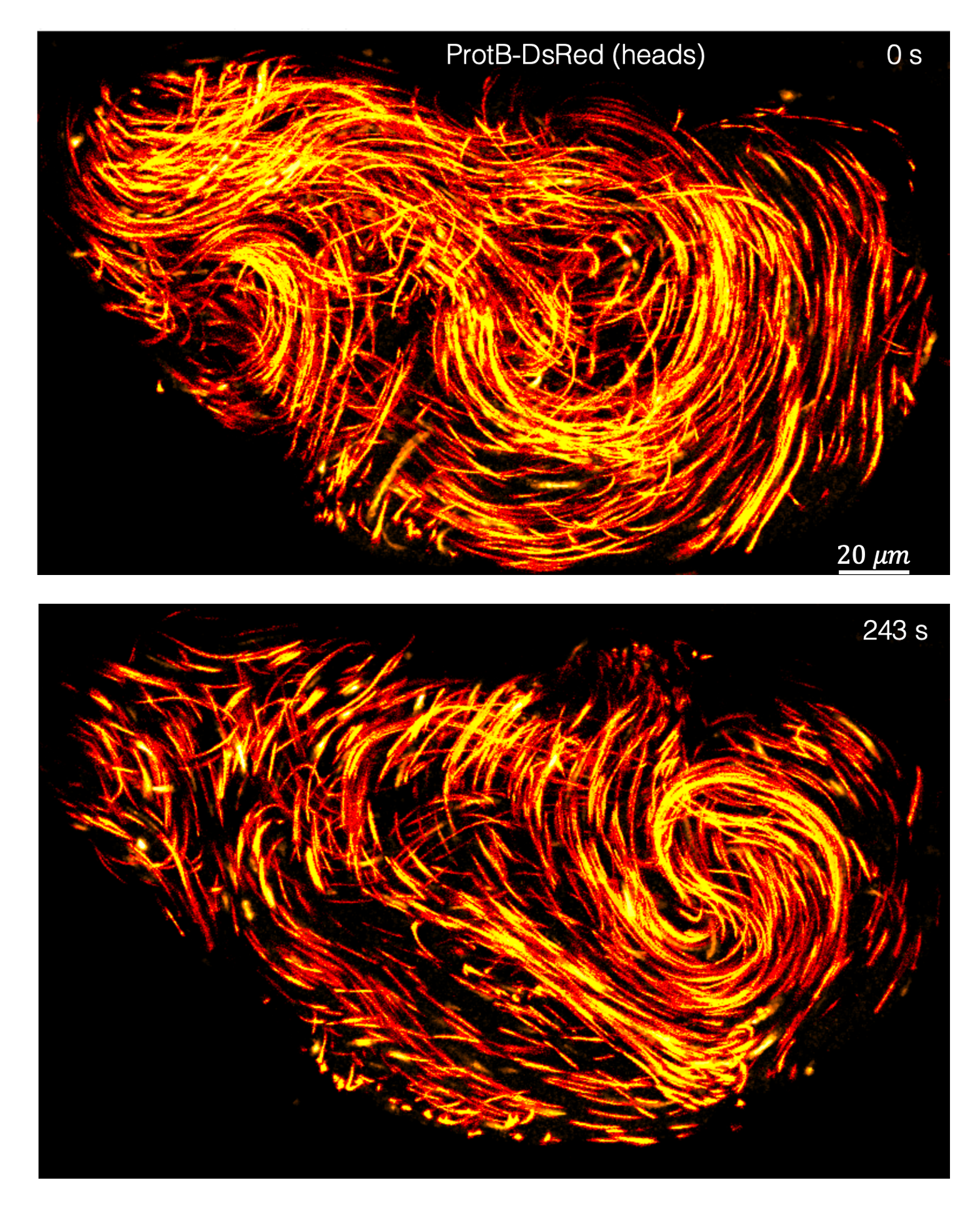
Combining live imaging, electron-microscopy reconstruction, filament-scale simulation and continuum theory, the team found the storage organ to be densely packed and remarkably well aligned, and highly dynamics. The whole assembly deforms slowly and continuously, buckling along its aligned directions and generating topological defects familiar from liquid crystals. It behaves, in short, like a living nematic liquid crystal, or like taffy being stretched and folded by a taffy puller.
Individual sperm move too, and much faster than the surrounding material, gliding along lanes set by their neighbours backbones. This is a striking observation since an isolated fly sperm does propagate bending waves along its backbone, but those waves produce almost no net translation. However, in the tight spaces of the storage organ individual sperm gains directed motility – an emergent mechanical consequence of its packing. The picture the team proposed is inspired by reptation of polymers: each sperm is topologically confined to a tube formed by its neighbours, its bending amplitude limited by that confinement, and it advances by pushing off flagella whose waves run the other way. Indeed, numerical simulations of discrete elastic filaments involving steric or contact interactions reproduce the key features from experiments and confirm this conceptual model.
Coarse-graining these contact interactions yields a continuum theory whose central prediction is an extensile active stress — the same class of stress that drives bacterial suspensions and microtubule–motor gels. Here it does something useful: it can sustain the aligned flagellar state and leads to a self-straining state of the material, whereby flagella do not get entangled – a possible insight to a biological puzzle. The same organization appears in the female's storage organ, where sperm are held for up to two weeks before fertilization.
Published in Nature Physics, the study establishes giant sperm in their native organ as a physiologically relevant active matter system — a rare case where an active nematic is not a laboratory construct but a working part of an animal. It also points to a broader programme: organisms with extreme traits make excellent laboratories for physics, because evolution has already pushed them to where ordinary intuition fails.
To read more about the work: Physics (APS), The New York Times, Phys.org
Image caption: Snapshots from a three-dimensional movie of labeled sperm heads inside the seminal vesicle (storage organ), showing local alignment and bending of the sperm “material”