
News
29 October 2025
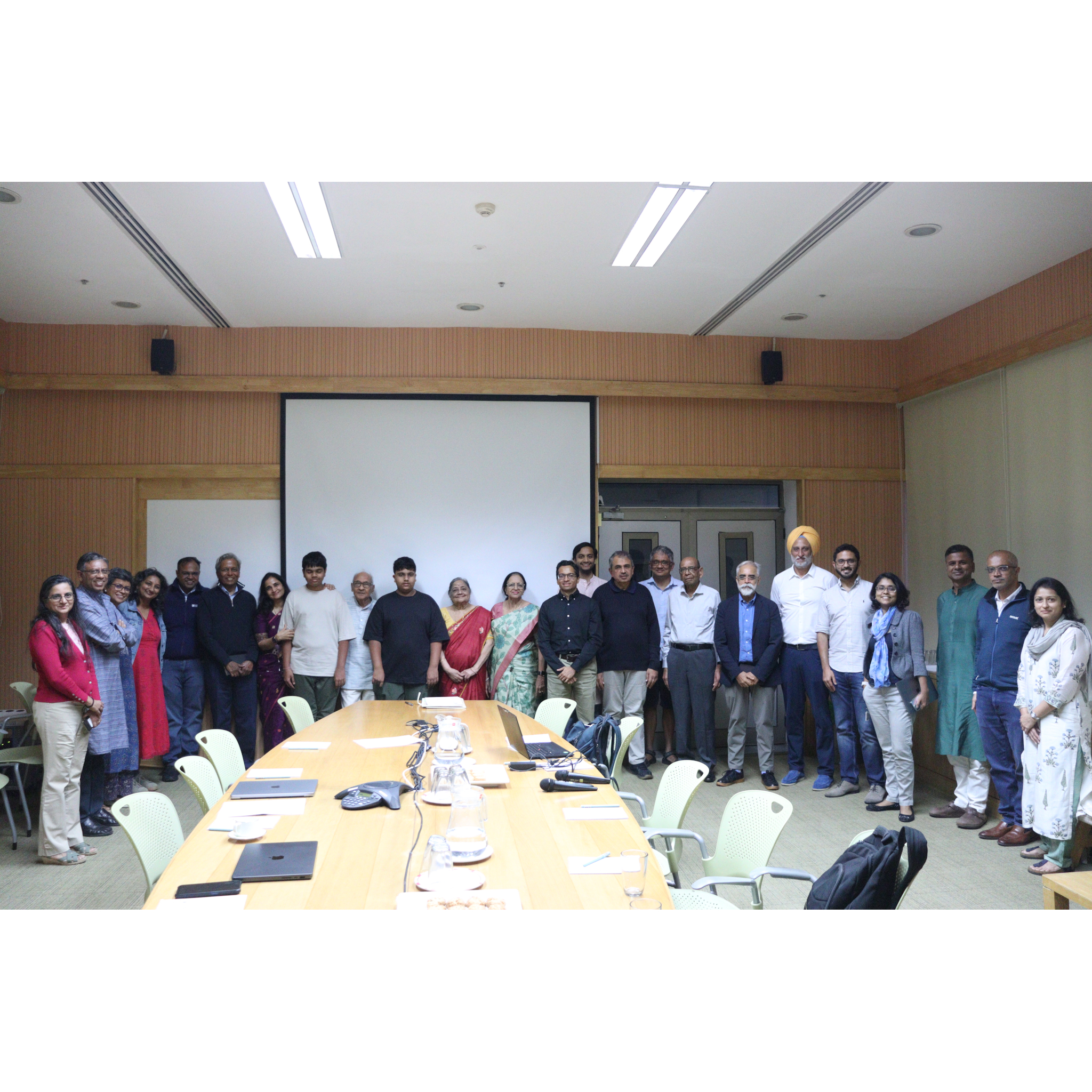
The International Centre for Theoretical Sciences (ICTS) and the National Centre for Biological Sciences (NCBS), both centres of the Tata Institute of Fundamental Research (TIFR), have signed an agreement to jointly establish a Centre for Artificial Learning and Intelligence for Biological Research and Education (CALIBRE).
The centre will be set up through a generous INR 25 crore contribution from Mr. Vishal Gupta, founder of Reed India Consulting LLP, and Major Deepshikha Gupta.
CALIBRE will be an interdisciplinary centre dedicated to advancing the integration of Artificial Intelligence (AI) in biological research, education and innovation.
While several AI platforms exist internationally, India requires its own context-specific AI tools and infrastructure to address challenges unique to Indian biodiversity, climate, health landscape, and fundamental research landscape. CALIBRE will serve as the national hub where biological insight meets AI innovation.
CALIBRE’s primary objectives are to:
1. Establish state-of-the-art infrastructure to harness the power of AI to transform biology research.
2. Develop advanced AI tools for basic, applied, and translational biology research.
3. Employ neuromorphic, brain-inspired computing approaches to advance AI technology.
4. Provide education and training to young Indian researchers to apply AI tools in biological research.
5. Create named Chair Professorships and Research Travel Fellowships to support biology research.
“ Biology for AI and AI for Biology - two frontiers converging, powered by India’s brightest minds at CALIBRE”.
— Mr. Vishal Gupta, Founder, Reed India Consulting LLP
"At ICTS we deeply appreciate this generous gift from Vishal Gupta and Deepshikha Gupta for setting up a unique centre like CALIBRE. This gift will help to jumpstart the research at ICTS, on quantitative biology with topics ranging from neuroscience, active matter and biophysics to the mathematical study of ecological systems. ICTS' deep strengths in the mathematical and theoretical sciences will help in the development of new AI techniques and tools with applications in biology as well as related areas of epidemiology and public health. Finally, the most exciting frontier is to use insights from the functioning and architecture of the brain itself to improve the current AI frameworks. Exciting days ahead!
— Prof. Rajesh Gopakumar, Centre Director, ICTS-TIFR
We are thankful to Mr Vishal Gupta and Deepshikha Gupta for coming forward to help us set up CALIBRE, which will help us employ AI tools in both basic and translational research in biological sciences. As NCBS researchers work across scales of biology - from molecules to forest ecosystem, our work will also help test and evaluate the power and limits of various AI tools, the outcome of which goes beyond accelerating our research to integrating AI in providing science-based solutions to health, agriculture and ecology.
— Prof. L. S. Shashidhara, Centre Director, NCBS