
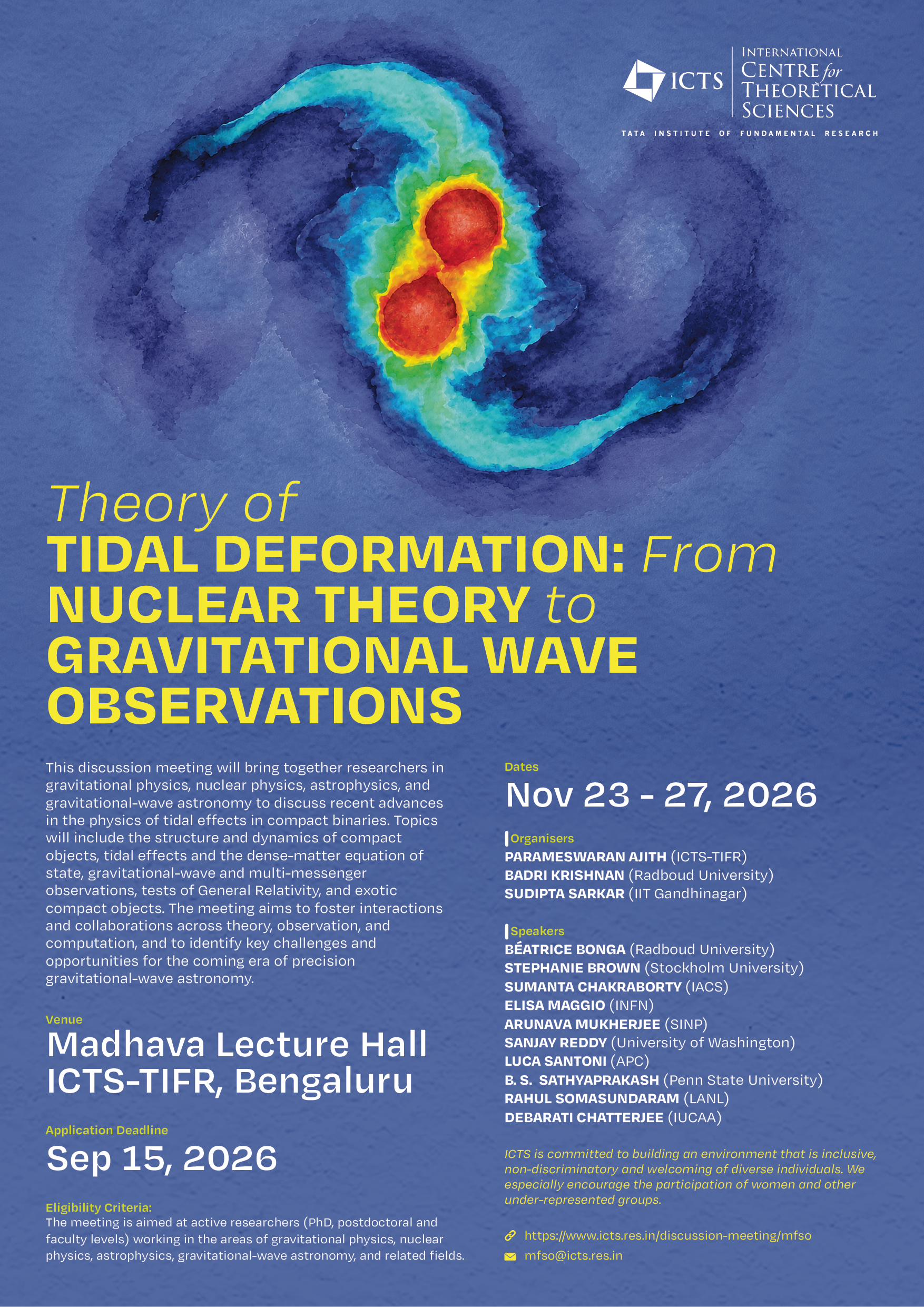
Measurements of the tidal deformability of compact objects such as neutron stars and black holes from gravitational-wave (GW) observations provide a unique probe of dense-matter properties, the internal structure of compact objects, and the dynamics of gravity. Combined with complementary electromagnetic observations, particularly in the X-ray band, these measurements are ushering in a new era of precision studies of neutron stars and strong-field gravity.
This discussion meeting will bring together researchers in gravitational physics, nuclear physics, astrophysics, and GW astronomy to discuss recent advances in the theory, modelling, and observations of compact objects. The scientific programme will focus on the following themes:
- Dense matter and compact objects: Equation of state of dense nuclear matter, neutron star structure, black holes, and exotic compact objects.
- Tidal effects in strong gravity: Tidal deformability, relativistic Love numbers, and their implications for the physics of neutron stars and other compact objects.
- Gravitational-wave and multi-messenger astronomy: Waveform modelling, parameter estimation, and constraints from GW and electromagnetic observations.
- Fundamental physics: Tests of General Relativity, alternative theories of gravity, and prospects with LIGO-India and next-generation gravitational-wave observatories.
Accommodation will be provided for outstation participants at our on campus guest house.
Eligibility criteria: The meeting is aimed at active researchers (PhD, postdoctoral and faculty levels) working in the areas of gravitational physics, nuclear physics, astrophysics, gravitational-wave astronomy, and related fields.
ICTS is committed to building an environment that is inclusive, non-discriminatory and welcoming of diverse individuals. We especially encourage the participation of women and other under-represented groups.
 icts
icts resin
resin- Other links