
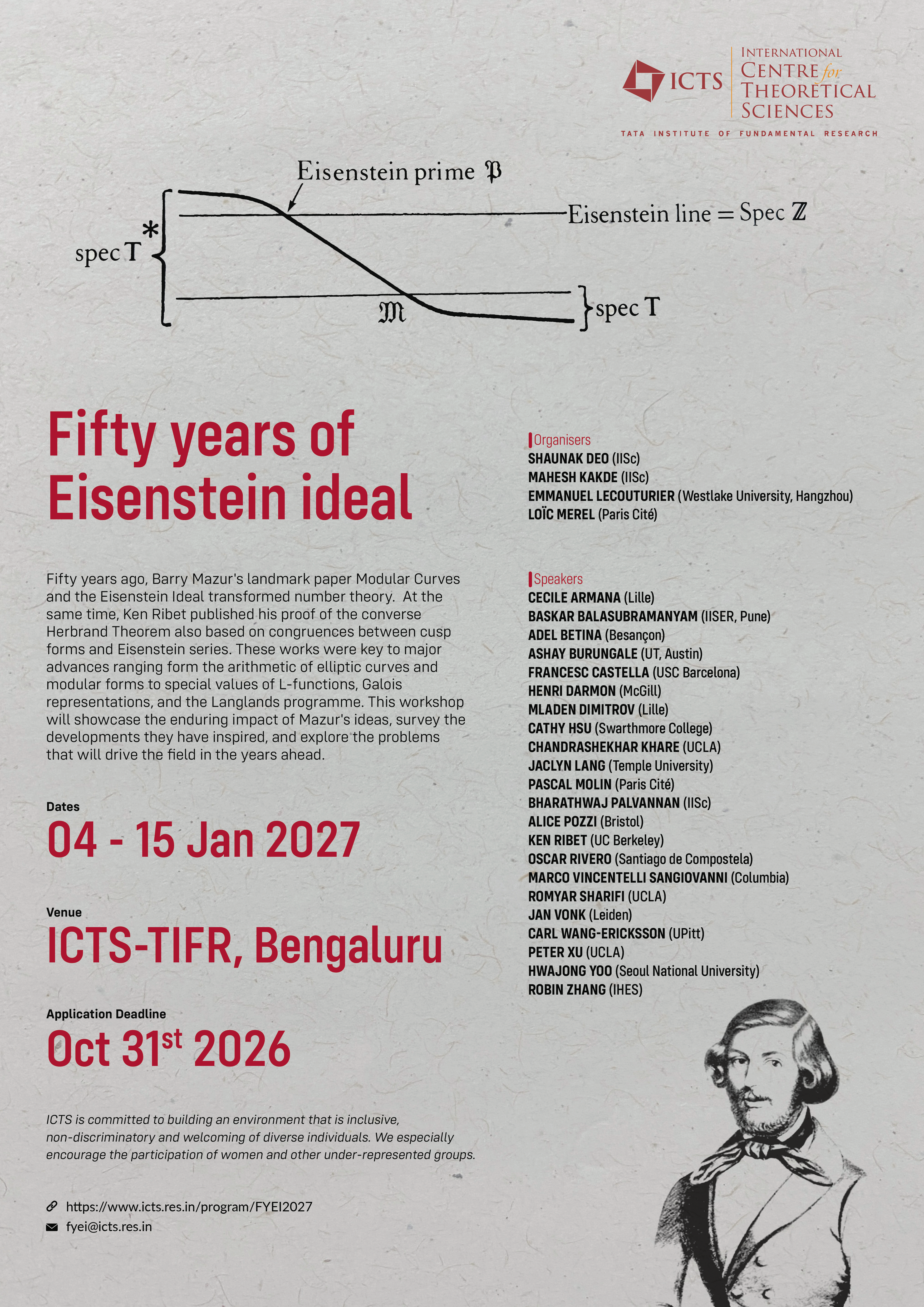
p-adic methods have been an integral part of number theory in the last hundred years. In particular, the congruences modulo prime powers between modular forms have played a crucial role in major advancements ranging from special values conjectures to Langlands programme, including Fermat’s last theorem. Barry Mazur has made pioneering contributions in this area, and his paper 'Modular curves and the Eisenstein ideal' is perhaps the single most influential paper on this theme. It is one of the first papers that uses the language of modern algebraic geometry, `a la Grothendieck, to obtain Diophantine results. Besides proving fundamental diophantine results such as classification of torsion points of elliptic curves defined over the rational numbers and Ogg’s conjecture, it introduced foundational methods, and raised several fascinating questions that have shaped a lot of modern arithmetic geometry and have stimulated research in the last 50 years since its publication in 1977. Several breakthroughs in the last 20 years due to Harris, Lecouturier, Merel, Sharifi, Skinner, Venkatesh etc. have their origins directly in Mazur’s paper. This workshop will celebrate fifty years of Mazur’s wonderful ideas, survey the remarkable developments that have grown out of them, and explore the new questions and conjectures that are likely to drive the field in the years ahead.
Eligibility Criteria: The workshop is primarily intended for graduate students, postdoctoral fellows, and faculty working in number theory, arithmetic geometry and related areas. Participants should have a solid background in algebraic number theory, elliptic curves, modular forms, and modular curves. Prior exposure to Galois representations, deformation theory, Iwasawa theory, or the Langlands programme will be useful.
Accommodation will be provided for outstation participants at our on-campus guest house.
ICTS is committed to building an environment that is inclusive, non-discriminatory, and welcoming of diverse individuals. We especially encourage the participation of women and other under-represented groups.
 icts
icts resin
resin- Application
- Other links