



Abstract:
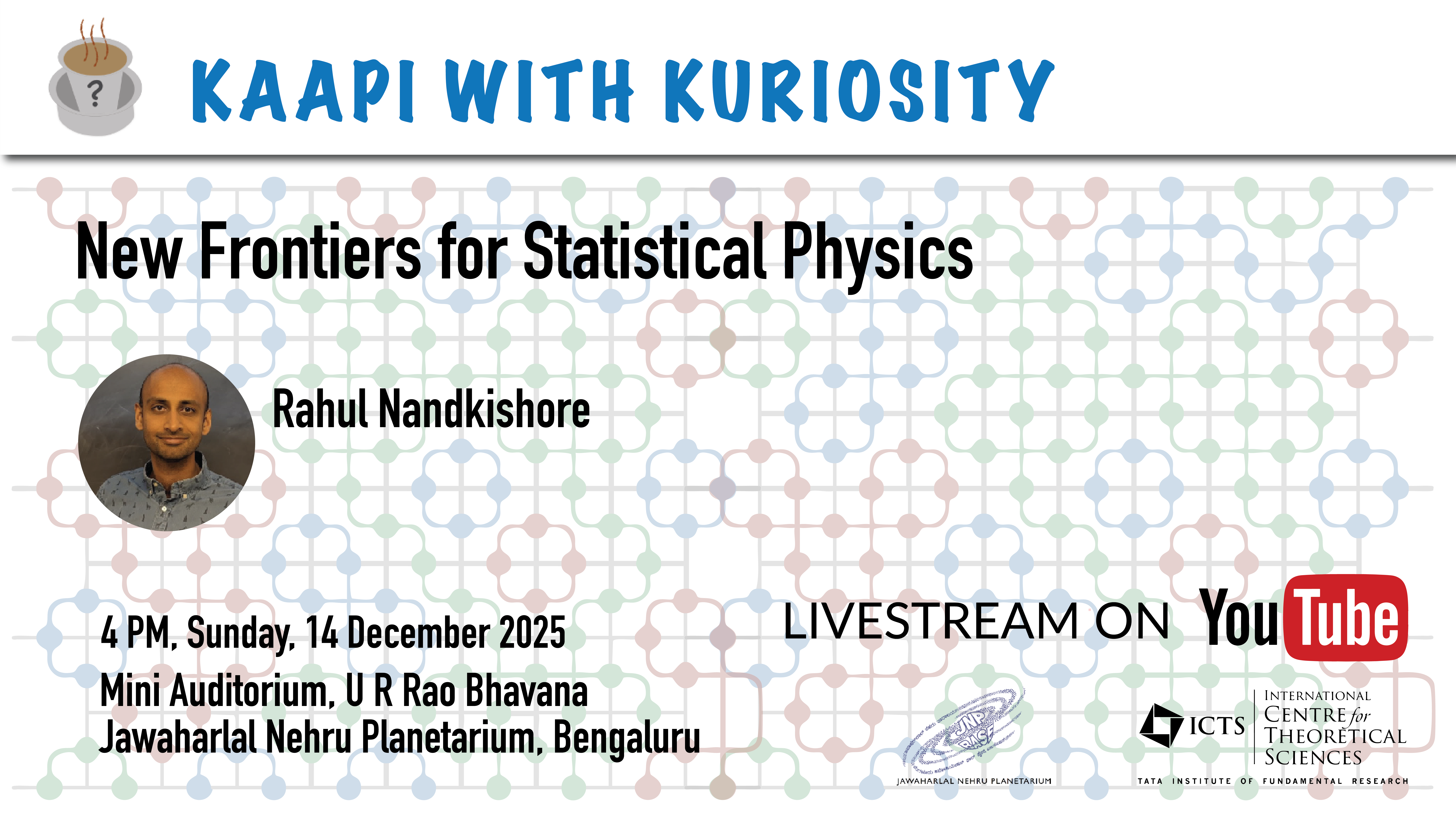
Traditional statistical physics assumes that systems go to equilibrium at long times. This leads to concepts like entropy and thermodynamics. But what if this assumption fails? When can (quantum) systems robustly fail to go to equilibrium, and what happens in that case? This question has been a central theme of research in quantum dynamics over the past decade, and I will share with you some highlights. I will present the rich and exotic phenomena that arise in ‘non-equilibrating’ systems and will discuss some key open directions for the field.
About the Speaker:
Rahul Nandkishore is a theoretical physicist interested in a broad range of problems. He received his PhD in 2012 from MIT, then spent three years at the Princeton Center for Theoretical Science as a postdoctoral fellow, before moving to the University of Colorado Boulder, where he is currently Professor of Physics. He is known for his work on graphene and Dirac semimetals, on many body localization, on fracton phases of matter, and on constrained quantum dynamics. His research has been recognized by numerous awards including Young Investigator awards from the U.S. Department of Defense, a Sloan Research Fellowship, a Simons Fellowship in Theoretical Physics, and the 2024 Anatoly Larkin award in theoretical physics.
Supported by Arista Networks India Pvt. Ltd