

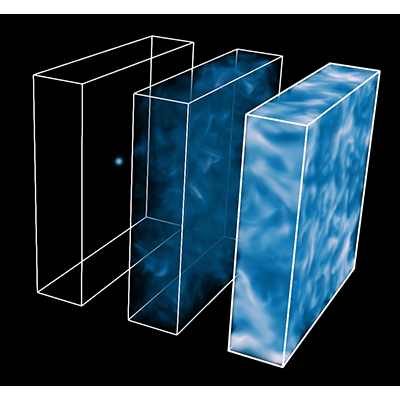
A team of researchers at ICTS have developed a new approach to quantify the growth of tiny perturbations in turbulent flows using high-resolution numerical simulations and theoretical analysis.
Turbulent flows are ubiquitous in nature and engineering, ranging from atmospheric and oceanic motions to industrial fluid transport. A central feature of turbulence is its chaotic behaviour, where two nearly identical flow states diverge rapidly with time. Although this sensitivity to initial conditions has been known for decades, the physical mechanisms controlling the rate of divergence remained poorly understood.
In this work, Subhro Bhattacharjee, Ritwik Mukherjee, Samriddhi Sankar Ray, former ICTS students Aikya Banerjee (University of Oxford) and Sugan Durai Murugan (IIT Madras) have shown that the rate at which perturbations grow is governed not by average properties of the flow, but by rare and intense fluctuations of the local velocity gradients. These intermittent events amplify perturbations much more efficiently than expected from classical theories.
The study establishes a direct connection between intermittency and chaos in turbulence, demonstrating that fluctuations in the local strain field determine how rapidly nearby flow states separate. The findings also explain why previous theoretical predictions underestimated the strength of chaos at high flow intensities. Independent tests using both direct simulations of fluid motion and simplified turbulence models yielded consistent results, indicating that the observed behaviour is robust.
These results provide a new microscopic understanding of the origin of chaos in turbulent flows and offer fresh insights into predictability, mixing, and transport processes in complex fluid systems. The work was published as Editors’ Suggestion in Physical Review Letters.
Image caption: Chaos in turbulence manifests as the rapid growth and spatial spread of an initially localized perturbation