
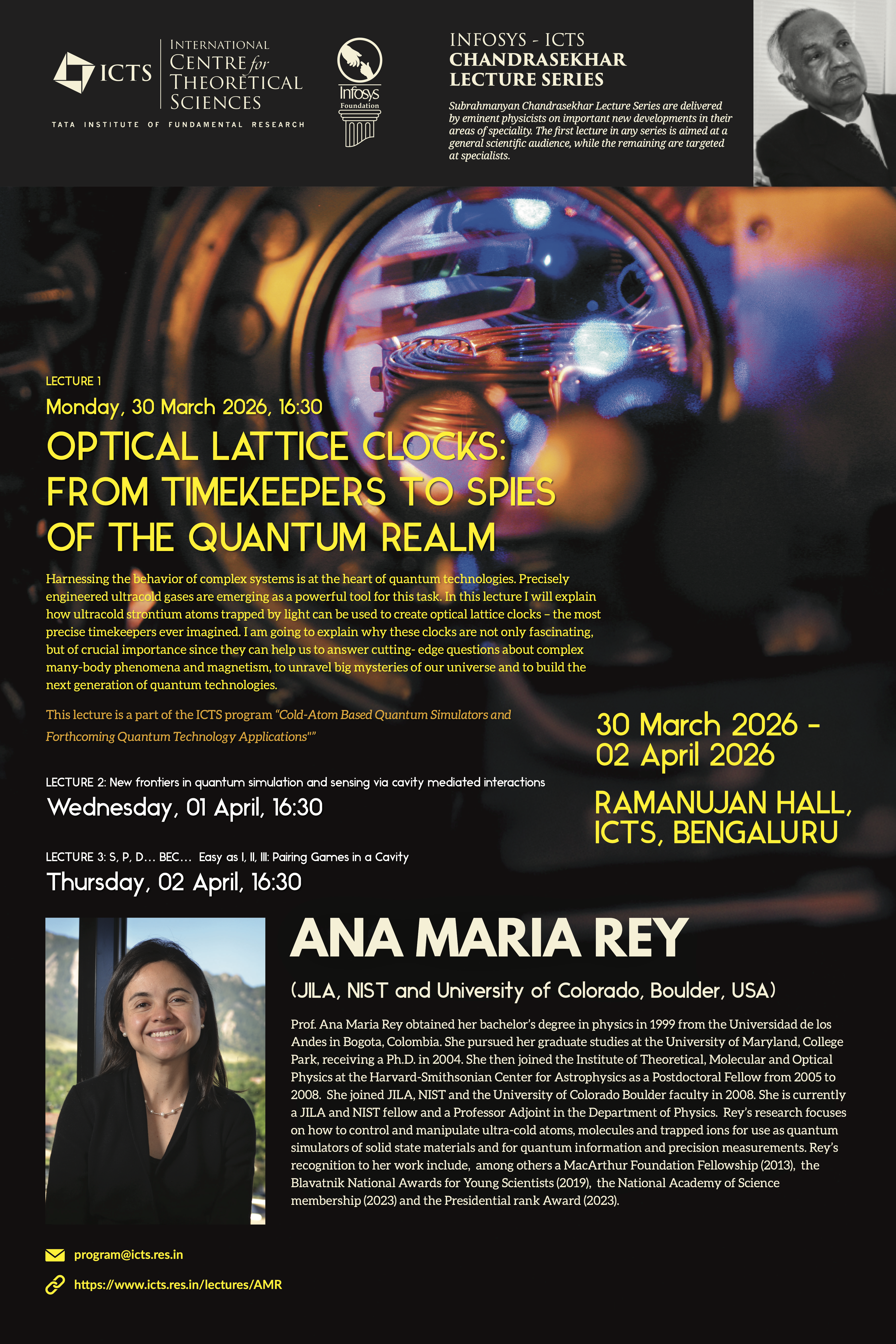
Lecture 1: 30 March 2026, 16:30-17:30
Title: Optical lattice clocks: From Timekeepers to Spies of the Quantum Realm
Abstract: Harnessing the behavior of complex systems is at the heart of quantum technologies. Precisely engineered ultracold gases are emerging as a powerful tool for this task. In this lecture I will explain how ultracold strontium atoms trapped by light can be used to create optical lattice clocks – the most precise timekeepers ever imagined. I am going to explain why these clocks are not only fascinating, but of crucial importance since they can help us to answer cutting- edge questions about complex many-body phenomena and magnetism, to unravel big mysteries of our universe and to build the next generation of quantum technologies.
Lecture 2: 01 April 2026, 16:30-17:30
Title: New frontiers in quantum simulation and sensing via cavity mediated interactions
Abstract: Atoms and photons are the fundamental building blocks of our universe. Their interactions rule the behavior of our physical world but at the same time can be extremely complex, especially in the context of many-body quantum systems. Understanding and harnessing them is one of the major challenges of modern quantum science. In recent years, ultracold atomic systems have emerged as a pristine platform for the exploration of atom-light interactions. In this lecture, I will discuss the potential of atomic systems loaded in optical cavities as a resource to enhance the energy scales needed to observe complex many-body behaviors by harnessing infinity range interactions mediated by photons that can couple a large set of internal levels. I will show how cavity systems can help us not only to shed light on behaviors of iconic Hamiltonians describing real materials but also to engineer broader classes of Hamiltonians with multi-body interactions too complex to emerge naturally. Furthermore , I will explain how they can facilitate the generation of quantum entanglement and overcome physical constraints currently limiting the performance of state-of-the-art atomic clocks and interferometers.
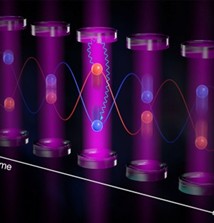
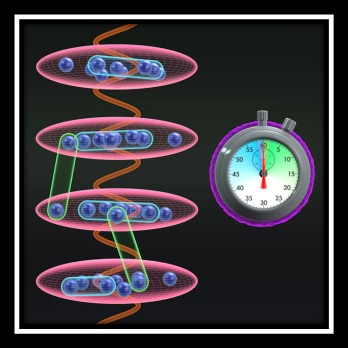
Figure: atoms in optical cavities are a unique platform for advancing quantum simulation and sensing.
Lecture 3: 02 April 2026, 16:30-17:30
Title: S, P, D… BEC… Easy as I, II, III: Pairing Games in a Cavity
Abstract: Superconductors are defined not just by whether electrons pair, but by how they pair. When multiple pairing symmetries compete, entirely new quantum phases can emerge — including topological states with protected edge currents. Yet in real materials, this competition is notoriously difficult to isolate and control.
In this lecture, I will introduce a cavity QED quantum simulator based on ultracold atoms in an optical lattice, where cavity photons mediate long-range interactions whose strength and symmetry can be tuned. Using an Anderson pseudospin mapping, I will explain how to realize superconducting phases with tunable symmetry, from conventional s-wave to topological p -wave and d-wave orders. I will also discuss our recent observation of the three dynamical phases of an s-wave BCS superconductor and how we directly tracked the order parameter in real time via non-destructive cavity measurements. More broadly, I will explain how this platform establishes a new paradigm for engineering and probing superconductivity in synthetic quantum matter.
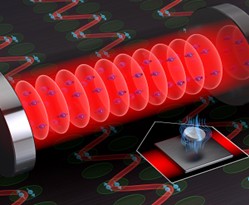
Figure:: The dynamic phases of BCS superconductor were observed in a Cavity QED by measuring the light leakage from the cavity
About the speaker: Prof. Ana Maria Rey obtained her bachelor’s degree in physics in 1999 from the Universidad de los Andes in Bogota, Colombia. She pursued her graduate studies at the University of Maryland, College Park, receiving a Ph.D. in 2004. She then joined the Institute of Theoretical, Molecular and Optical Physics at the Harvard-Smithsonian Center for Astrophysics as a Postdoctoral Fellow from 2005 to 2008. She joined JILA, NIST and the University of Colorado Boulder faculty in 2008. She is currently a JILA and NIST fellow and a Professor Adjoint in the Department of Physics. Rey’s research focuses on how to control and manipulate ultra-cold atoms, molecules and trapped ions for use as quantum simulators of solid state materials and for quantum information and precision measurements. Rey’s recognition to her work include, among others a MacArthur Foundation Fellowship (2013), the Blavatnik National Awards for Young Scientists (2019), the National Academy of Science membership (2023) and the Presidential rank Award (2023).
This lecture series is part of the discussion meeting "Cold-Atom Based Quantum Simulators and Forthcoming Quantum Technology Applications"