

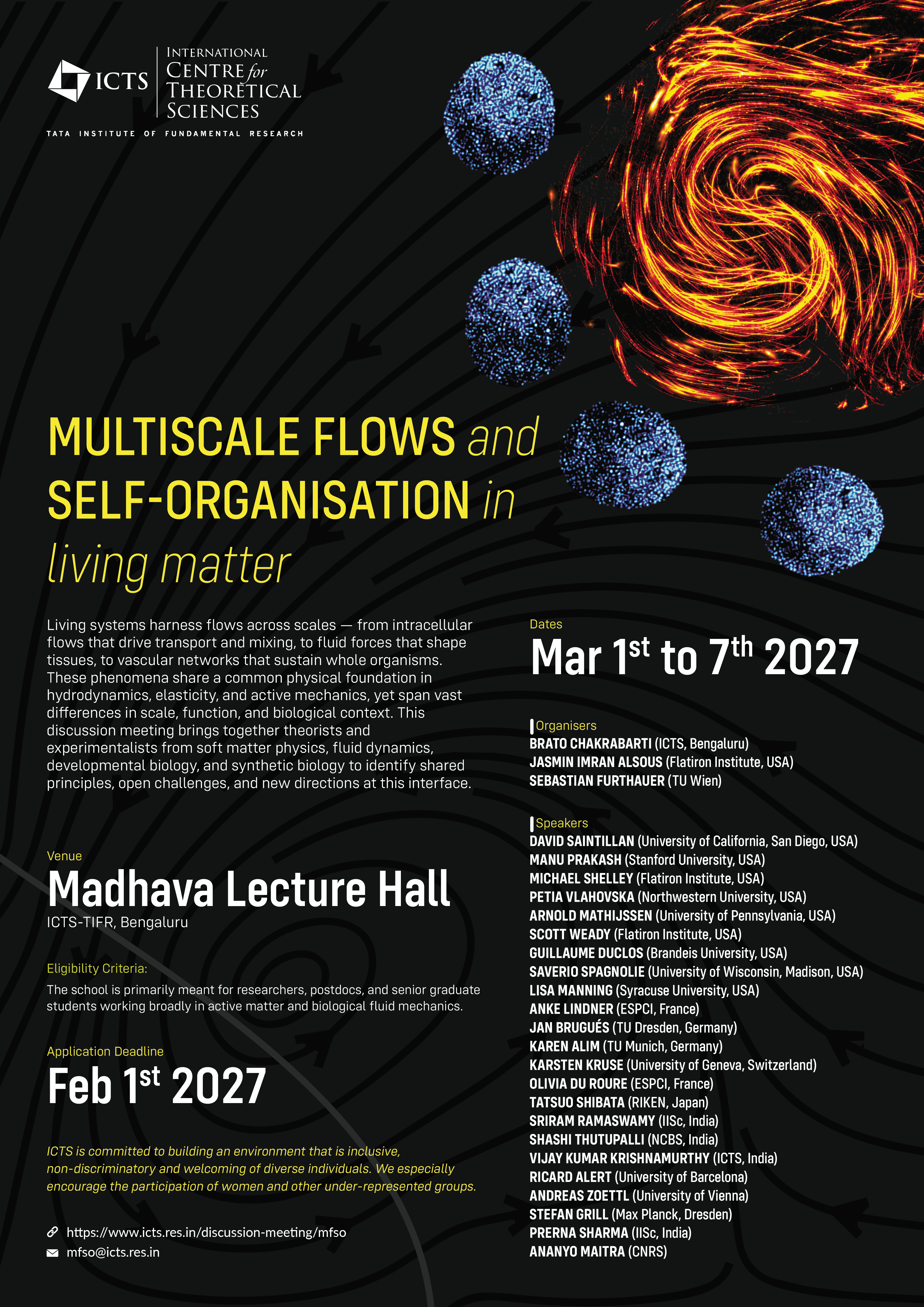
Living systems generate, regulate, and respond to flows across a remarkable range of scales — from intracellular currents that position organelles, to tissue-level fluid forces that shape embryos, to vascular networks that sustain organs. Despite differences in biological function and spatial extent, these phenomena share a common physical foundation: hydrodynamics, elasticity, and active nonequilibrium mechanics. Understanding how these principles operate — and how evolution has tuned them for robustness — is one of the central challenges at the interface of physics and biology.
Recent advances in theory, computation, and experiment have begun to reveal how flows and mechanical forces organise biological structure and function. New imaging tools now allow direct observation of dynamics in living tissue; synthetic and biomimetic systems are beginning to replicate key features of living flows; and theoretical models have uncovered recurring motifs — symmetry breaking, pattern formation, topological structures — that appear across scales and systems. Yet significant open questions remain, particularly around how biological feedback and biochemical regulation steer mechanical processes, and how insights from different scales can be integrated into coherent predictive frameworks.
This discussion meeting will bring together experimentalists and theorists working across soft matter physics, fluid dynamics, developmental biology, and synthetic biology. The program will feature research talks and a poster session, and extended discussions designed to foster exchange across disciplines.
Eligibility Criteria : The school is primarily meant for researchers, postdocs, and senior graduate students working broadly in active matter and biological fluid mechanics.
Accommodation will be provided for outstation participants at our on campus guest house.
ICTS is committed to building an environment that is inclusive, non-discriminatory and welcoming of diverse individuals. We especially encourage the participation of women and other under-represented groups.
 icts
icts resin
resin- Application
- Other links