

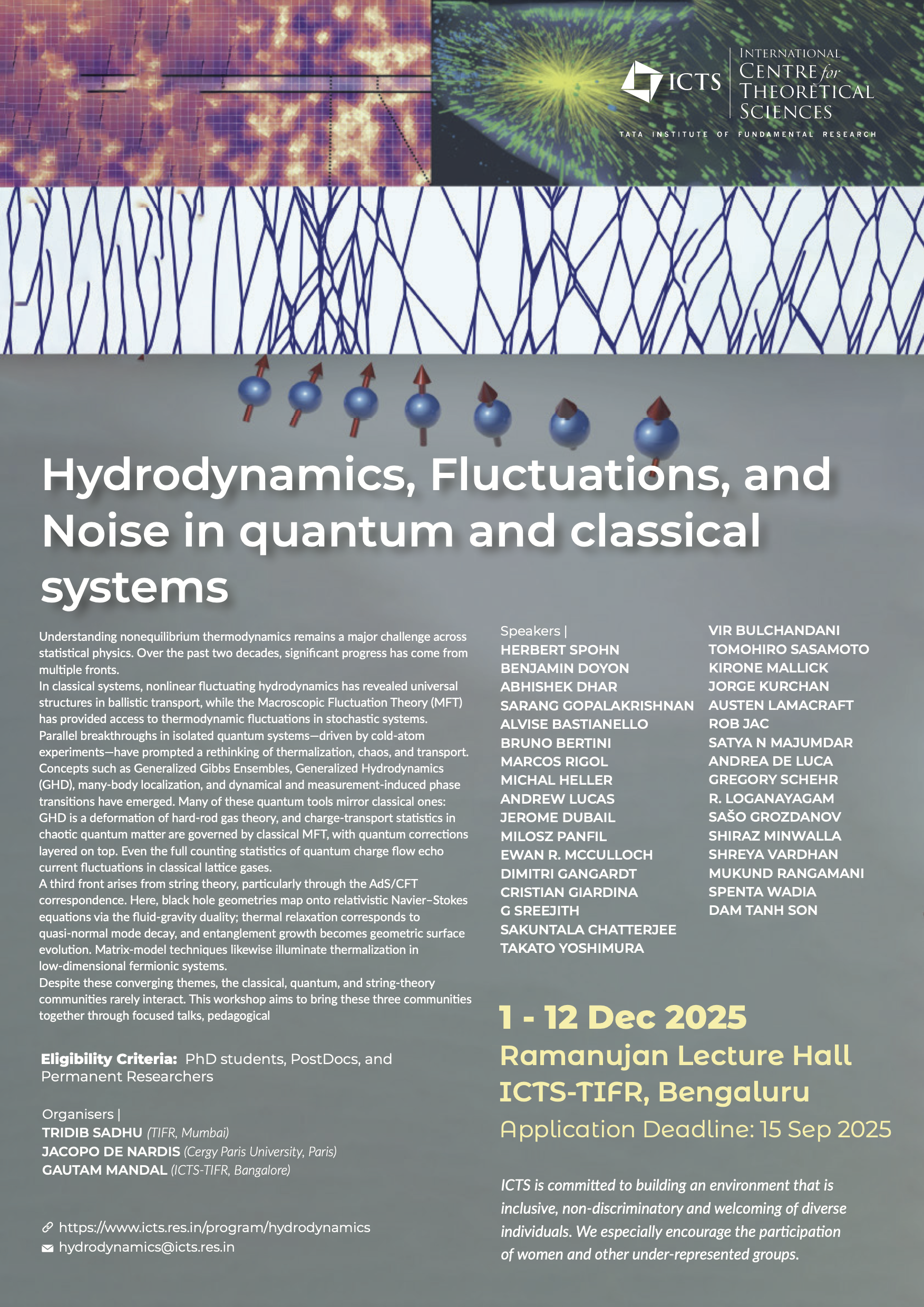
Understanding nonequilibrium thermodynamics remains a major challenge across statistical physics. Over the past two decades, significant progress has come from multiple fronts.
In classical systems, nonlinear fluctuating hydrodynamics has revealed universal structures in ballistic transport, while the Macroscopic Fluctuation Theory (MFT) has provided access to thermodynamic fluctuations in stochastic systems.
Parallel breakthroughs in isolated quantum systems—driven by cold-atom experiments—have prompted a rethinking of thermalization, chaos, and transport. Concepts such as Generalized Gibbs Ensembles, Generalized Hydrodynamics (GHD), many-body localization, and dynamical and measurement-induced phase transitions have emerged. Many of these quantum tools mirror classical ones: GHD is a deformation of hard-rod gas theory, and charge-transport statistics in chaotic quantum matter are governed by classical MFT, with quantum corrections layered on top. Even the full counting statistics of quantum charge flow echo current fluctuations in classical lattice gases.
A third front arises from string theory, particularly through the AdS/CFT correspondence. Here, black hole geometries map onto relativistic Navier–Stokes equations via the fluid-gravity duality; thermal relaxation corresponds to quasi-normal mode decay, and entanglement growth becomes geometric surface evolution. Matrix-model techniques likewise illuminate thermalization in low-dimensional fermionic systems.
Despite these converging themes, the classical, quantum, and string-theory communities rarely interact. This workshop aims to bring these three communities together through focused talks, pedagogical lectures, and discussion sessions, fostering new collaborations on nonequilibrium hydrodynamics.
Accommodation will be provided for outstation participants at our on campus guest house.
Eligibility Criteria: PhD students, Postdocs, and Permanent Researchers
ICTS is committed to building an environment that is inclusive, non-discriminatory and welcoming of diverse individuals. We especially encourage the participation of women and other under-represented groups.
 icts
icts resin
resin