



Abstract
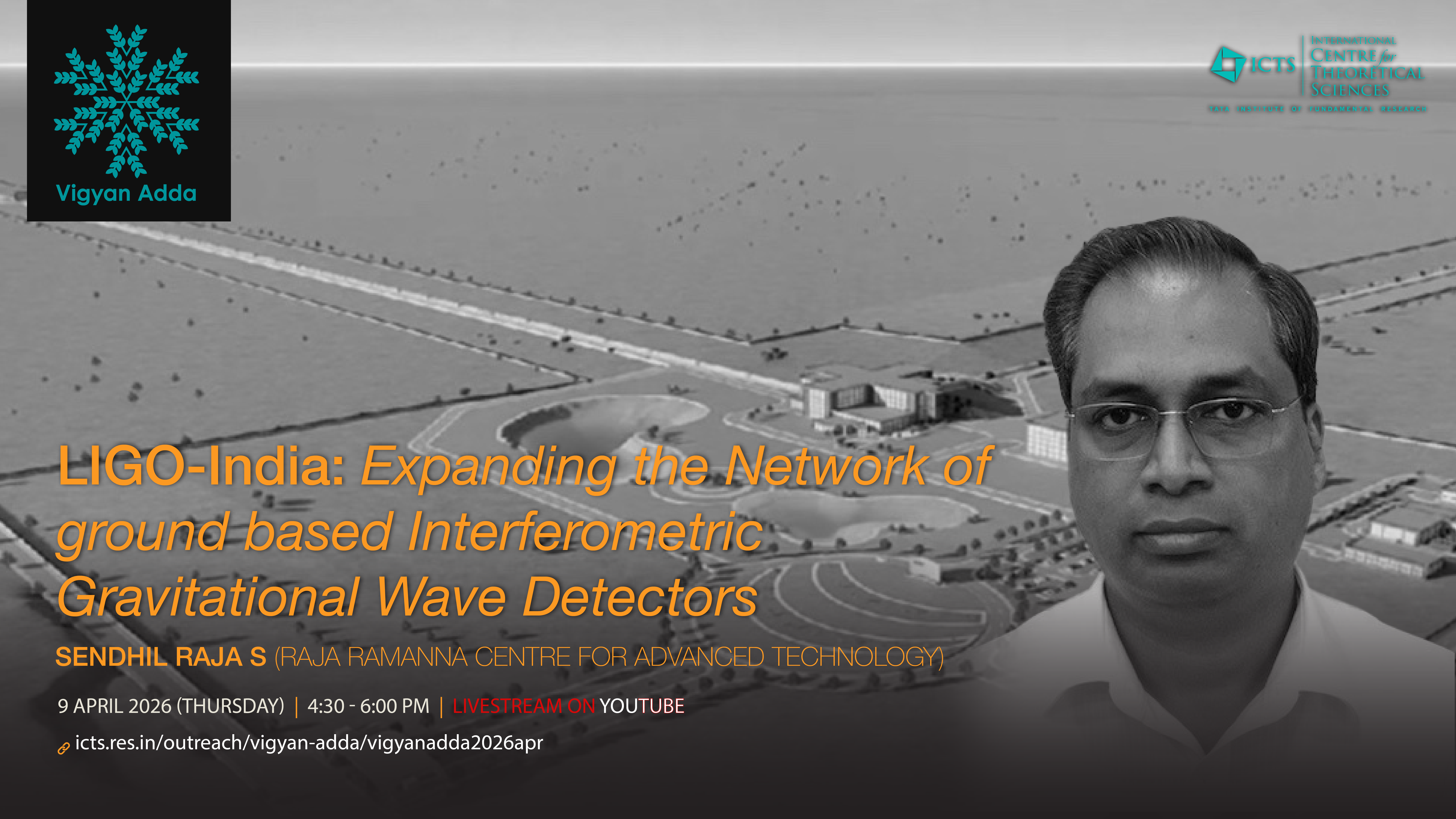
Every step in the direction of our fundamental understanding of the Universe has required pushing the limits of existing technology to build more precise and more sensitive instruments, which in turn require the development of new techniques for ultra-precision fabrication. The Laser Interferometer Gravitational Wave Observatory, or LIGO as it is popularly known, is a 4 km arm length laser interferometer designed and developed for detecting the minuscule contraction and expansion of space due to passing gravitational waves, and is arguably the most complex and precise instrument that humankind has ever built to understand the universe. The talk will provide a brief overview of the Advanced LIGO detector, the ultra-precision technologies that needed to be developed, the engineering challenges and complexities that went into achieving the required sensitivity to be able to detect and measure Gravitational Waves. The talk will also provide a brief update on the LIGO-India Project for building a LIGO Observatory in India in collaboration with LIGO USA.
About the Speaker
Sendhil Raja S. received his B.Sc degree in Physics from P.S.G. College of Arts & Science, Coimbatore in 1994. After receiving his M.Sc degree in Physics from the Indian Institute of Technology Madras, in 1996, he joined the Raja Ramanna Centre for Advanced Technology to pursue a career in optical instrumentation. He received his Ph.D. in Physics from the Indian Institute of Technology Madras, Chennai, in 2009. He is a recipient of the Young Technologist Award of the Department of Atomic Energy for the year 2006. As part of the LIGO Scientific Collaboration, he is a recipient of the “Special Breakthrough Prize in Fundamental Physics” for the year 2016. He currently heads the Advanced Lasers and Optics Division of the Lasers Group at Raja Ramanna Centre for Advanced Technology, Indore. His expertise is in optical system design, optical instrumentation, and optical systems engineering. He is the Project Leader and Project Spokesperson for the LIGO-India Project.
Please register to receive the Zoom Meeting Link.
Target Audience: Undergraduate students, post-graduates, researchers, and anyone fascinated by the intersection of high-end engineering and fundamental physics!
Supported by: Arista Networks India Pvt. Ltd.