

ICTS faculty member Sthitadhi Roy and students Saptarshi Mandal and Alan Sherry have used a new approach to probe how information is shared across different parts of a complex quantum system.
Quantum many-body systems can hide and spread information in remarkably subtle ways. When many quantum particles interact, information initially stored in a small part of the system can rapidly disperse across the whole system through a process known as information scrambling. Understanding how this information is distributed — and when it can be accessed — is a central challenge in modern quantum physics, with implications ranging from quantum computing to the physics of black holes.
In this work, instead of relying only on standard measures of entanglement — which quantify quantum correlations between subsystems — the authors studied projected ensembles. These are collections of quantum states that arise in one part of a system when another disjoint, and often far-away, subsystem is measured and the measurement outcomes define a statistical ensemble for the former. The statistical properties of this ensemble provide a more refined lens for examining how information can be hidden or revealed through measurements.
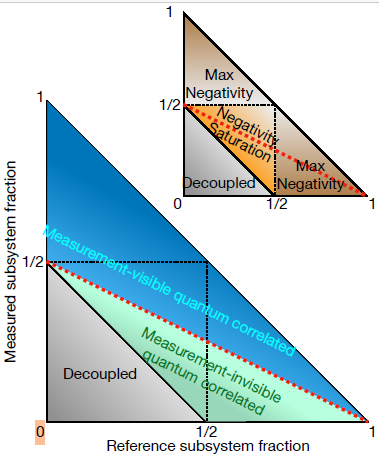
Using analytical calculations together with numerical simulations, Prof. Roy, Mandal and Sherry showed that projected ensembles generated by scrambling quantum circuits exhibit distinct “information phases.” As the relative sizes of the subsystems change, the amount of accessible information behaves in qualitatively different ways. In one phase, the accessible information becomes exponentially small as the system grows, meaning that the information is effectively hidden from local measurements. In another phase, it grows linearly with system size, indicating that the information remains readily accessible. These phases are separated by sharp transitions and reveal structures that conventional entanglement measures cannot detect. Their results therefore provide a new way to understand how quantum information can be distributed, hidden, and revealed in complex quantum systems.
Their publication, titled Information Phases of Partial Projected Ensembles Generated from Random Quantum States and Scrambling Dynamics, has been highlighted as Editors’ Suggestion in Physical Review B.