
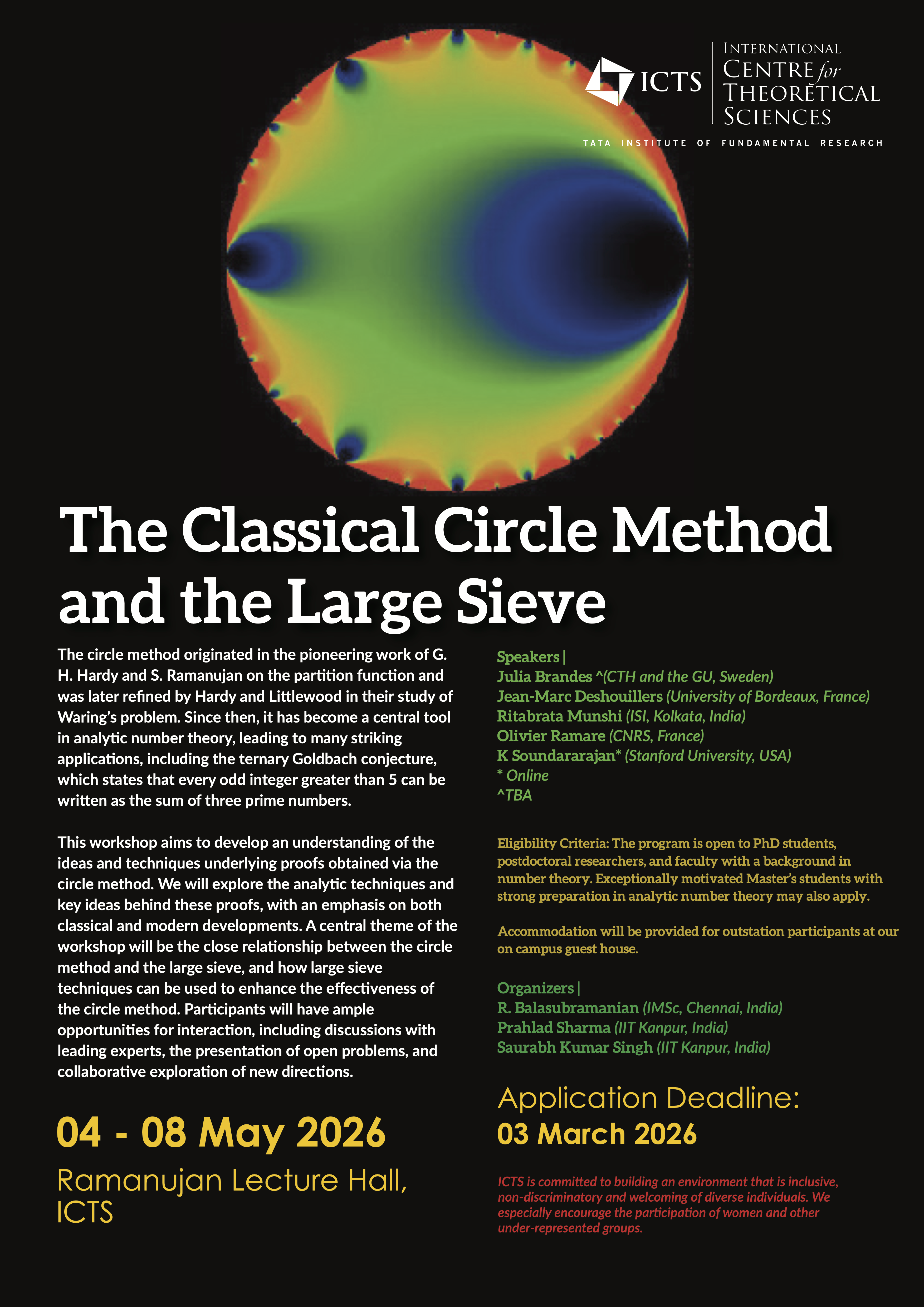
The circle method originated in the pioneering work of G. H. Hardy and S. Ramanujan on the partition function and was later refined by Hardy and Littlewood in their study of Waring’s problem. Since then, it has become a central tool in analytic number theory, leading to many striking applications, including the ternary Goldbach conjecture, which states that every odd integer greater than 5 can be written as the sum of three prime numbers.
This workshop aims to develop an understanding of the ideas and techniques underlying proofs obtained via the circle method. We will explore the analytic techniques and key ideas behind these proofs, with an emphasis on both classical and modern developments. A central theme of the workshop will be the close relationship between the circle method and the large sieve, and how large sieve techniques can be used to enhance the effectiveness of the circle method. Participants will have ample opportunities for interaction, including discussions with leading experts, the presentation of open problems, and collaborative exploration of new directions.
Eligibility criteria: The program is open to PhD students, postdoctoral researchers, and faculty with a background in number theory. Exceptionally motivated Master’s students with strong preparation in analytic number theory may also apply.
Accommodation will be provided for outstation participants at our on campus guest house.
ICTS is committed to building an environment that is inclusive, non-discriminatory and welcoming of diverse individuals. We especially encourage the participation of women and other under-represented groups.
 icts
icts resin
resin