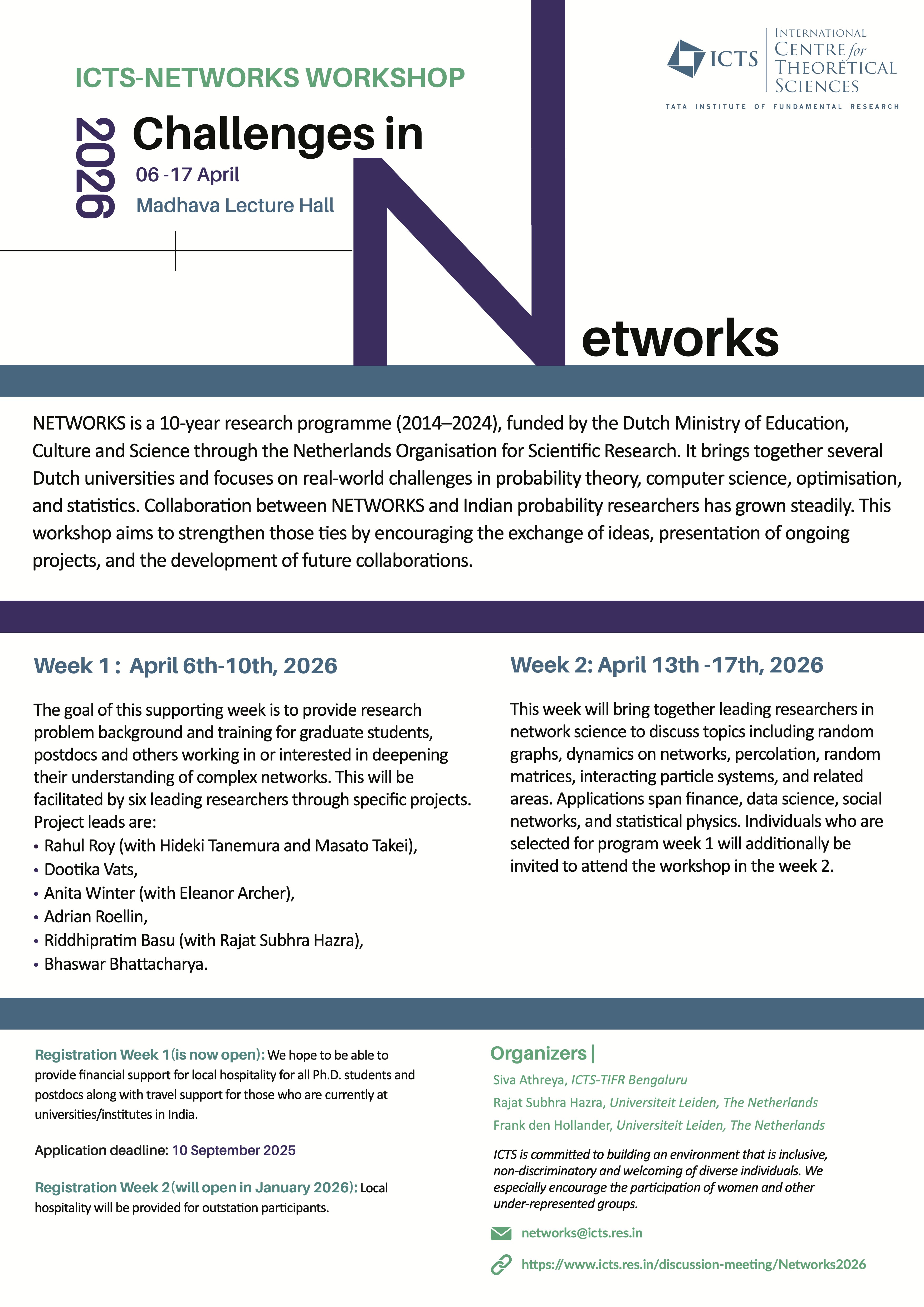
The two week meeting is divided into two parts. Week 2, i.e. April 13th-17th will be a workshop featuring talks by researchers, open problem sessions and poster sessions. Week 1, i.e. April 6th -12th is intended as a supporting week for graduate students and post-doctoral fellows.
Week 1 : April 6th-10th, 2026
The goal of this supporting week is to provide research problem background and training for graduate students, postdocs and others working in or interested in deepening their understanding of complex networks. To maximize the benefit of the activity for junior participants, week 1 will have a pedagogical component. Specifically, it will feature a number of lectures by each of 6 established researchers who will discuss the foundations of the field, while exposing connections to current research on the topics covered in the main workshop in week 2. Each researcher will aim to outline a research project that will be worked on by a group of 5-7 students/postdocs as a team. The following experts will act as leads:
- Rahul Roy, with co-leads Hideki Tanemura and Masato Takei
- Dootika Vats
- Anita Winter with co-lead Eleanor Archer
- Adrian Roellin
- Riddhipratim Basu with co-lead Rajat Subhra Hazra
- Bhaswar Bhattacharya
The afternoons will be primarily reserved for the participants who will work on projects in respective groups. We plan to reserve several one-hour blocks for students and postdocs to present their own work.
Week 1- Registration form and application for travel and local hospitality (is now open): We hope to be able to provide financial support for local hospitality for all Ph.D. students and postdocs along with some partial travel support for students/postdocs who are currently at universities/institutes in India. If you are student or postdoc and are interested in participating then please fill out the application form before September 1, 2025 5pm, IST. A recommendation letter from your Ph.D. supervisor/mentor is required by September 10th, 2025 5pm, IST for the application to be complete.
Week 2: April 13th -17th, 2026
The aim of the program during week 2 is to bring in leading researchers in network science for an active discussion and exchange of ideas. NETWORKS is a long-term programme (started in 2014) funded by the Dutch Ministry of Education, Culture and Science through the Netherlands Organisation for Scientific Research. Several Dutch universities belong to this group. Many Indian scientists are in active collaboration with the NETWORKS group, and the workshop in week 2 will form a platform for exchange of ideas and projects and further collaborations. The NETWORKS project focusses on real-world applications of theoretical developments in probability theory, computer science, optimization, and statistics. Earlier joint meetings included a symposium at the Indian Statistical Institute in Kolkata (2018), one-day workshops in the Netherlands during 2017–2019, and a meeting at ICTS in 2024.
Topics we plan to cover include: Structural properties of random graph/networks; dynamics on networks; Interacting particle systems on networks like spread of infection, contact process, voter models; algorithmic aspects of networks; percolation on networks; random matrices, statistical physics and related fields; population genetics.
The researchers participating in the workshop are leading experts in random matrices, random graphs and processes on random graphs, algorithms and optimization, complex physical systems, and long-range dependent models. Their work has applications in finance, large-scale data analysis, rare-event modeling, and social networks. The workshop will bring together specialists from all these areas to ensure active interaction. Individuals who are selected for the program in week 1 will additionally be invited to attend the workshop in the week 2.
Week 2- Registration form and application for travel and local hospitality (will open in January 2026): Accommodation will be provided for outstation participants at our on campus guest house.
ICTS is committed to building an environment that is inclusive, non-discriminatory and welcoming of diverse individuals. We especially encourage the participation of women and other under-represented groups.
 icts
icts resin
resin