Error message

Monday, 18 August 2025
Time Speaker Title Resources
10:00 to 11:00 Ulrich Pinkall (TU Berlin) Constrained Willmore Surfaces - I (Online)

We investigate surfaces with prescribed conformal type in 3-space that minimize the Willmore functional.

11:30 to 12:30 Pradip Kumar (Shiv Nadar University, India) Complete finite energy equivariant minimal surfaces in CH^2

We will discuss $\rho$-equivariant conformal minimal immersions of finite energy into $\mathbb{CH}^2$. We prove that the induced metric is complete at a puncture $p$ if and only if the holonomy of $\rho$ around $p$ is parabolic. In this case $f$ is proper and $\partial f$ has pole at each puncture, so on the compactification $\Sigma$ we obtain a parabolic $\mathrm{PU}(2,1)$–Higgs bundle $(E,\Phi)$ with nilpotent residues and zero parabolic weights. This yields an Osserman-type extension principle for minimal surfaces in $\mathbb{CH}^2$ with complete ends. We further provide an algebro–geometric characterization of these immersions in terms of their associated parabolic Higgs data. This is a joint work with Indranil Biswas and John Loftin.

14:30 to 15:30 Felix Schulze (University of Warwick, UK) Generic regularity for minimizing hypersurfaces up to dimension 11 - I (Online)

We will give an introduction to our recent joint work with Otis Chodosh, Christos Mantoulidis and Zhihan Wang on generic regularity for area minimizing hypersurfaces up to dimension 11.

16:30 to 17:00 Anu Dhochak (ICTS-TIFR, Bengaluru, India) Construction of maxfaces with infitely many swallowtails and planar ends.

In this talk, I will discuss the existence of a one-parameter family of infinite genus maxfaces exhibiting infinitely many planar spacelike ends.

17:15 to 17:45 Subham Paul (Indian Institute of Technology Patna, India) Decompositions of Scherk-Type Zero Mean Curvature Surfaces

Using a special Euler–Ramanujan identity and Wick rotation, we reveal how Scherk-type zero mean curvature surfaces in Lorentz–Minkowski space can be decomposed into superpositions of dilated helicoids and hyperbolic helicoids. These decompositions also extend to maximal codimension-2 surfaces, linking them to weakly untrapped and ∗-surfaces.

17:45 to 18:15 Aditya Tiwari (IISER Mohali, India) Does the unit sphere minimize the Laplacian eigenvalues under certain curvature constraints?

The unit sphere minimizes the first positive Laplacian eigenvalue among all compact n-dimensional manifolds with Ricci curvature bounded below by n−1, as a consequence of Lichnerowicz's Theorem. This naturally raises a question about the higher Laplacian eigenvalues: Does the unit sphere minimize all the Laplacian eigenvalues? In this talk, we will explore a class of manifolds whose Laplacian eigenvalues are strictly greater than the corresponding eigenvalues of the unit sphere. These examples provide evidence for such a general minimization in dimensions two and three.

Tuesday, 19 August 2025
Time Speaker Title Resources
10:00 to 11:00 Ulrich Pinkall (Technische Universität Berlin, Germany) Constrained Willmore Surfaces - II (Online)

We investigate surfaces with prescribed conformal type in 3-space that minimize the Willmore functional.

11:30 to 12:30 Rahul Kumar Singh (Indian Institute of Technology Patna, India) Algebraicity of CMC surfaces of revolution

In this talk, first we will show that for every spacelike CMC surface of revolution (except spacelike cylinders and standard hyperboloids) about a timelike axis or spacelike axis, which is either an unduloid or a nodoid, in the Lorentz-Minkowski space L^3 there is an associated Weierstrass-P function. Next, using this association, we will show that unduloid and nodoid cannot be algebraic. A similar result is obtained for CMC surfaces of revolution in the Euclidean space E^3.

14:30 to 15:30 Felix Schulze (University of Warwick, UK) Generic regularity for minimizing hypersurfaces up to dimension 11 - II (Online)

We will give an introduction to our recent joint work with Otis Chodosh, Christos Mantoulidis and Zhihan Wang on generic regularity for area minimizing hypersurfaces up to dimension 11.

16:30 to 17:00 Vishnu Nandakumaran (University of Notre Dame, USA) Uniqueness to the Plateau problem near quadratic cones

I shall consider minimal hypersurfaces inside the unit ball whose boundary on the sphere is a small perturbation of the link of a minimizing quadratic cone. In this talk, I will discuss a recent result where I show that such minimal surfaces are uniquely determined by their boundary condition. In particular the solutions of the Plateau problem are unique for boundary conditions given by small perturbations of the link of a quadratic cone. Building on previous results we can characterize these unique surfaces. This is a joint work with Gábor Székelyhidi.

17:15 to 18:15 Mike Wolf (Georgia Institute of Technology, USA) Asymptotics of High Energy Harmonic Maps from Riemann surfaces - I (Online)

We describe the asymptotics of high energy harmonic maps from Riemann surfaces to locally symmetric spaces in special classes in two settings: surface group actions on PSL(2,\R) and on SL(3,\R).  The goal is to highlight some aspects of technique, though inevitably we will state some results that follow from the methods. Joint work with Dumas, Loftin, Tamburelli, and Pan, if not others.

Wednesday, 20 August 2025
Time Speaker Title Resources
10:00 to 11:00 Mike Wolf (Georgia Institute of Technology, USA) Asymptotics of High Energy Harmonic Maps from Riemann surfaces - II (Online)

We describe the asymptotics of high energy harmonic maps from Riemann surfaces to locally symmetric spaces in special classes in two settings: surface group actions on PSL(2,\R) and on SL(3,\R).  The goal is to highlight some aspects of technique, though inevitably we will state some results that follow from the methods. Joint work with Dumas, Loftin, Tamburelli, and Pan, if not others.

11:30 to 12:30 Felix Schulze (University of Warwick, UK) Generic regularity for minimizing hypersurfaces up to dimension 11-III (Online)

We will give an introduction to our recent joint work with Otis Chodosh, Christos Mantoulidis and Zhihan Wang on generic regularity for area minimizing hypersurfaces up to dimension 11.

Thursday, 21 August 2025
Time Speaker Title Resources
10:00 to 11:00 Franz Pedit (University of Massachusetts Amherst, USA) Loop groups and harmonic maps-I

In these two lectures I will explain how loop groups and loop algebras can be used to express the equations for a harmonic map of a Riemann surface into a symmetric space by meromorphic data---a generalized Weierstrass representation. I will discuss how to apply this method to special situations such as the construction of constant mean curvature surfaces in the 3-sphere. The lectures are intended as an introduction into this topic.

11:30 to 12:30 Charles Ouyang (Washington University in St. Louis, USA) Minimal surfaces with and without Higgs bundles-I

Harmonic maps to symmetric spaces are used in the non-Abelian Hodge correspondence to bridge surface group representations with Higgs bundles. In special cases, these harmonic maps are conformal and hence give minimal surfaces in a symmetric space. In the first lecture, we look at the case of SL(3,R) and describe some asymptotics via Blaschke metrics.

In the second lecture, we will look at higher genus minimal Lagrangians in CP^2. There will be objects reminiscent of Higgs bundles, but which are not Higgs bundles. This will involve loop group methods and satisfying a closing condition.

14:30 to 15:00 Anusha Bhattacharya (IISER Mohali, India) Graph discretization of Riemannian manifolds with Ricci bounds: Approximating spectrum of the Laplacian

We study the approximation of eigenvalues for the Laplace-Beltrami operator on closed Riemannian manifolds in the class characterized by bounded Ricci curvature, a lower bound on the injectivity radius, and an upper bound on the diameter. We use an (\epsilon,\rho)-approximation of the manifold by a weighted graph, as introduced by Burago et al. By adapting their methods, we prove that as the parameters \epsilon, \rho and the ratio \frac{\epsilon}{\rho} approach zero, the k-th eigenvalue of the graph Laplacian converges uniformly to the k-th eigenvalue of the manifold's Laplacian for each k.

15:00 to 15:30 Rivu Bardhan (Shiv Nadar Institution of Eminence, India) Higher Genus angel Surfaces

We prove the existence of complete minimal surfaces in $\mathbb{R}^3$ of arbitrary genus $p\, >\, 1$ and least absolute curvature with precisely two ends --- one catenoidal and one Enneper-type --- thereby resolving, affirmatively, a conjecture posed by Weber. These surfaces, which are called \emph{Angel surfaces}, generalize the genus-one example constructed earlier by Fujimori and Shoda. We extend the orthodisk method developed by Weber and Wolf, \cite{weber2002teichmuller}, to construct the minimal surfaces. A central idea in our construction is the notion of \emph{partial symmetry}, which enables us to introduce controlled symmetry into the surface. Reference: [Weber and Wolf(2002)] Matthias Weber and Michael Wolf. Teichm¨uller theory and handle addition for minimal surfaces. Annals of mathematics, pages 713–795, 2002.

16:30 to 17:00 Priyank Vasu (Indian Institute of Technology Patna, India) Timelike minimal surface in $\mathbb{E}^3_1$ with arbitrary ends

In this talk, we show the existence of a timelike minimal surface with an arbitrary number of weak complete ends. Then, we discuss the asymptotic behaviour of the simple ends.

17:15 to 18:15 Mike Wolf (Georgia Institute of Technology, USA) Asymptotics of High Energy Harmonic Maps from Riemann surfaces-III (Online)

We describe the asymptotics of high energy harmonic maps from Riemann surfaces to locally symmetric spaces in special classes in two settings: surface group actions on PSL(2,\R) and on SL(3,\R).  The goal is to highlight some aspects of technique, though inevitably we will state some results that follow from the methods. Joint work with Dumas, Loftin, Tamburelli, and Pan, if not others.

Friday, 22 August 2025
Time Speaker Title Resources
10:00 to 11:00 Franz Pedit (University of Massachusetts Amherst, USA) Loop groups and harmonic maps-II

In these two lectures I will explain how loop groups and loop algebras can be used to express the equations for a harmonic map of a Riemann surface into a symmetric space by meromorphic data---a generalized Weierstrass representation. I will discuss how to apply this method to special situations such as the construction of constant mean curvature surfaces in the 3-sphere. The lectures are intended as an introduction into this topic.

11:30 to 12:30 Charles Ouyang (Washington University in St. Louis, USA) Minimal surfaces with and without Higgs bundles-II

Harmonic maps to symmetric spaces are used in the non-Abelian Hodge correspondence to bridge surface group representations with Higgs bundles. In special cases, these harmonic maps are conformal and hence give minimal surfaces in a symmetric space. In the first lecture, we look at the case of SL(3,R) and describe some asymptotics via Blaschke metrics.

In the second lecture, we will look at higher genus minimal Lagrangians in CP^2. There will be objects reminiscent of Higgs bundles, but which are not Higgs bundles. This will involve loop group methods and satisfying a closing condition.

14:30 to 15:00 Jason Lotay (University of Oxford, UK) Introduction to Lagrangian mean curvature flow: theory

Lagrangian mean curvature flow is potentially a powerful tool for tackling problems in symplectic geometry via geometric analysis, by studying the existence problem for minimal Lagrangian submanifolds. In this first talk I will give an overview of Lagrangian mean curvature flow and describe some of the key foundational results.

16:30 to 17:00 Sai Rasmi Ranjan Mohanty (Shiv Nadar University, India) Higher genus maxfaces with arbitrarily many catenoid or planar ends

Maximal surfaces in 3-dimensional Lorentz-Minkowski space arise as solutions to the variational problem of local area maximizing among the spacelike surfaces. These surfaces are zero mean curvature surfaces, and maximal surfaces with singularities are called generalized maximal surfaces. Maxfaces are a special class of these generalized maximal surfaces where singularities appear at points where the tangent plane contains a light-like vector. I will present the construction of a new family of maxfaces of high genus that are embedded outside a compact set and have arbitrarily many catenoid or planar ends using the node opening technique. The surfaces look like spacelike planes connected by small necks. Among the examples are maxfaces of the Costa-Hoffman-Meeks type. More specifically, the singular set form curves around the waists of the necks. In generic and some symmetric cases, all but finitely many singularities are cuspidal edges, and the non-cuspidal singularities are swallowtails evenly distributed along the singular curves. This work is conducted in collaboration with Dr. Hao Chen, Dr. Anu Dhochak, and Dr. Pradip Kumar.

17:15 to 18:15 Jason Lotay (University of Oxford, UK) Introduction to Lagrangian mean curvature flow: examples

In this second talk on Lagrangian mean curvature flow, I will focus on key examples which illustrate the theory from the previous talk. In particular, we will see important objects arising in symplectic and Riemannian geometry, such as the Clifford torus, Whitney sphere and Lawlor necks.

Monday, 25 August 2025
Time Speaker Title Resources
10:00 to 11:00 Jason Lotay (University of Oxford, UK) Recent progress in Lagrangian mean curvature flow of surfaces

-In this talk I will describe recent advances in our understanding of the behaviour of Lagrangian mean curvature flow when the evolving submanifolds are 2-dimensional surfaces. In this case, we now have improved understanding of singularity formation and important examples which validate aspects of the well-known Thomas-Yau and Joyce conjectures.

11:30 to 12:30 Subhojoy Gupta (Indian Institute of Science) Harmonic maps and framed PSL(2,C)-representations

For a closed Riemann surface X, and an irreducible representation R from the fundamental group of X to PSL(2,C), a seminal theorem of Donaldson proves the existence of an R-equivariant harmonic map from the universal cover of X into hyperbolic 3-space. We shall discuss a generalization of this result to the case when X is a punctured Riemann surface arising from an element of the enhanced Teichmüller space, and R is a framed PSL(2,C)-representation. Our technique involves the harmonic map heat flow, and the relation between the asymptotic behaviour of a harmonic map and the singular-flat geometry of its Hopf differential. This is joint work with Gobinda Sau. 

14:30 to 15:30 Indranil Biswas (Shiv Nadar University, Noida, India) Holomorphic Higgs bundles over the Teichmuller space

arXiv:2308.13860 (joint work with Lynn Heller and Sebastian Heller).

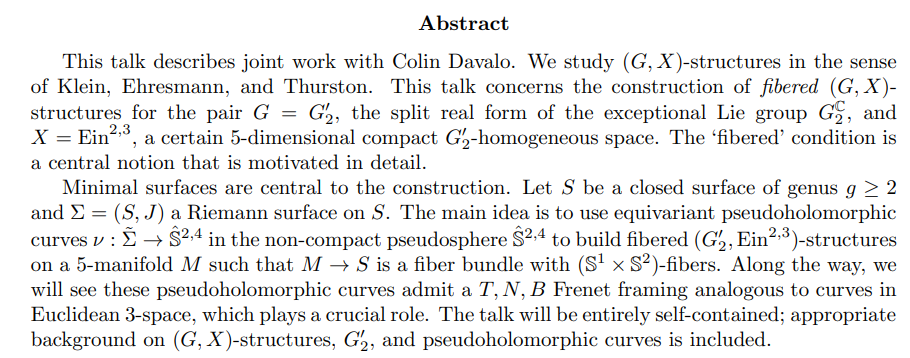
16:30 to 17:30 Parker Evans (Washington University in St. Louis, USA) G′ 2 -Geometry: Pseudoholomorphic Curves to Geometric Structures


Tuesday, 26 August 2025
Time Speaker Title Resources
10:00 to 11:00 Barbara Nelli (University of L'Aquila, Italy) Maximum Principle for Elliptic PDE and Geometric Applications-I

Hopf Maximum Principle for linear elliptic PDE (interior and boundary versions).

11:30 to 12:30 Masashi Yasumoto (Tokushima University, Japan) Discrete zero mean curvature surfaces: past, present, and future

Discrete minimal surfaces in the Euclidean space are central in the research field discrete differential geometry. Similarly, we can consider discrete spacelike maximal surfaces and discrete timelike minimal surfaces in Lorentz-Minkowski space. Although their formulation is analogous to discrete minimal surfaces, their behaviors are quite different.

In this talk we introduce recent progress on discrete zero mean curvature surfaces in Euclidean and Lorentz-Minkowski spaces. After briefly introducing basic results on discrete minimal surfaces, we investigate discrete zero mean curvature surfaces in Lorentz-Minkowski space and their singular behaviors. Furthermore, if time permits, we will introduce a construction of discrete zero mean curvature surfaces in Lorentz-Minkowski space that change causal characters along specific singularities.

This talk is partially based on ongoing project with Joseph Cho, Wayne Rossman, and Seong-Deog Yang.

14:30 to 15:30 Ben Sharp (University of Leeds, UK) Index estimates for constant mean curvature surfaces in 3-manifolds

CMC (constant mean curvature) surfaces are critical with respect to area as long as we restrict to competitor surfaces which 'enclose the same volume'. The index of a CMC surface is the number of ways we can locally deform it to reduce its area whilst enclosing the same amount of volume. We will show that the index of a CMC surface is bounded linearly from above in terms of its genus and a Willmore-type energy i.e. the more unstable a surface is the more genus and/or ‘Willmore energy’ it must have. Joint work with Luca Seemungal. 

16:30 to 17:30 Benjamin Lowe (University of Chicago, USA) Finiteness of Totally Geodesic Hypersurfaces in Negative Curvature

There is a broad body of work devoted to proving theorems of the following form: spaces with infinitely many special sub-spaces are either nonexistent or rare. Such finiteness statements are important in algebraic geometry, number theory, and the theory of moduli space and locally symmetric spaces. I will talk about joint work with Simion Filip and David Fisher proving a finiteness statement of this kind in a differential geometry setting. Our main theorem is that a closed negatively curved analytic Riemannian manifold with infinitely many closed totally geodesic hypersurfaces must be isometric to an arithmetic hyperbolic manifold. The talk will be more focused on providing background and context than details of proofs and should be accessible to a general audience.

17:40 to 18:10 Savita Rani (ICTS-TIFR, Bengaluru, India) Biconservative Hypersurfaces in the Pseudo-Euclidean Space

This talk presents a study of biconservative hypersurfaces M4r(r = 0, 1, 2, 3, 4) in the pseudo-Euclidean space E5s(s = 0, 1, 2, 3, 4, 5) with constant norm of the second fundamental form. We find that every such hypersurface in E5s with a diagonal shape operator has constant mean curvature and constant scalar curvature. This is a joint work with Ram Shankar Gupta, Andreas Arvanitoyeorgos, and Marina Statha.

Thursday, 28 August 2025
Time Speaker Title Resources
10:00 to 11:00 Barbara Nelli (University of L'Aquila, Italy) Maximum Principle for Elliptic PDE and Geometric Applications-II

Maximum principle for general elliptic PDE, with applications to minimal and constant mean curvature graphs.

11:30 to 12:30 Marina Ville (CNRS, Université Paris-Est Créteil) Minimal surfaces in R^4

Complete minimal surfaces in R^3 have been much studied but much less is known about R^4. I will recall the main tools in R^4 and give a couple of examples of minimal embeddings of the complex plane in R^4. Then I will focus on complete minimal tori of curvature -8π and one end: in R^3 there is a unique example (the Chen-Gackstetter square torus) but in R^4 we can construct examples on all the rectangular tori. I will discuss the strategy for the construction and indicate the many questions which remain open. Joint work with Marc Soret.

14:30 to 15:30 Rukmini Dey (ICTS-TIFR, Bengaluru, India) Interpolation by zero mean curvature and constant mean curvature surfaces and related problems.

We will talk of interpolation problems of two types.

First type of interpolation we talk of is that given two real analytic curves can one interpolate them with a minimal or maximal surface or a CMC surface? -- a version of Plateau's problem. For minimal surfaces this problem was solved by Douglas and Rado in great generality. We show that indeed, if the curves are "close" enough in a certain sense, then interpolation is possible. We will also talk of existence of a maximal surface containing a given real analytic curve and a special singularity, under certain conditions.

The second type of interpolation we will talk about is given a array of surfaces placed at some periodic intervals, can one interpolate them by a minimal/maximal surface, in the sense that the height functions of surfaces at these arrays sum up to a height function of a minimal/maximal surface.This work uses some Euler-Ramanujan identities.

16:30 to 17:30 Rob Kusner (University of Massachusetts at Amherst, USA) Minimally Embedding Compact Surfaces in Round Spheres and Balls (Online)

We discuss the topological realization problem for minimally embedding compact surfaces in round spheres and balls. In 1970, using the solution to the Plateau problem, Lawson constructed orientable minimal surfaces of each genus embedded in $S^3$. In recent work with Karpukhin, McGrath and Stern, using equivariant eigenvalue optimization methods and a priori eigenspace dimension bounds, we constructed orientable free boundary minimal surfaces in $B^3$ of any genus and (positive) number of boundary, components. Now we have extended our methods to handle the nonorientable case, constructing embedded minimal surfaces in $S^4$ diffeomorphic to the connect-sum of any number of real projective planes: these all have area (so Willmore bending energy) under $8\pi$ and enjoy other interesting geometric features. The analogous construction for nonorientable free boundary minimal surfaces embedded in $B^4$ looms on the horizon. Open problems and speculation about potential discretizations may be offered if time permits....

Friday, 29 August 2025
Time Speaker Title Resources
10:00 to 11:00 Jonathan Zhu (University of Washington, USA) Capillary minimal surfaces in spherical caps (Online)

Minimal surfaces in the round 3-sphere enjoy a number of attractive and influential rigidity properties, particularly in low genus. Progress has been made in extending these results to certain analogous settings, such as free boundary minimal surfaces in the Euclidean ball. We will propose perspectives by which these other settings may be studied within a continuous family starting with the round 3-sphere. In this talk, we’ll discuss (half-space) intersection properties, connections with capillary minimal surfaces and other free boundary problems. This is based on joint work (including some in progress) with Keaton Naff.

11:30 to 12:30 Barbara Nelli (University of L'Aquila, Italy) Maximum Principle for Elliptic PDE and Geometric Applications-III

Further applications: Alexandrov Theorem and Serrin Theorem.